- This topic is empty.
Viewing 1 post (of 1 total)
Viewing 1 post (of 1 total)
- You must be logged in to reply to this topic.
XRD Research Hub › Forums › XRD Forum › XRD Basics › Q. What are X-rays?
 Editor
Answer: X-rays are a form of high-energy electromagnetic radiation with wavelengths ranging approximately from 0.01 to 10 nanometers (nm). They possess much shorter wavelengths and higher energies than visible light, allowing them to penetrate many materials. This unique property makes X-rays useful in medical imaging, industrial inspection, and scientific research.
Unlike visible light, X-rays are invisible to the human eye. They travel at the speed of light and exhibit wave-particle duality, behaving as both electromagnetic waves and photons.
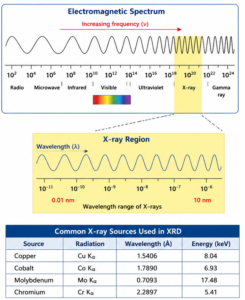
Figure 1. Position of X-rays in the electromagnetic spectrum. X-rays occupy the region between ultraviolet (UV) radiation and gamma rays and have wavelengths ranging from approximately 0.01 to 10 nm, making them suitable for crystal structure analysis using X-ray diffraction.
If you have any questions related to X-rays or X-ray diffraction (XRD), feel free to ask in the comments below. Our community will be happy to help.